Imagine two farmers. One farmer’s crop consists entirely of corn. The other grows a mix of corn, wheat, soy and potatoes. Then one season a terrible blight destroys many corn plants and significantly reduces yields. Which farmer is going have more of a problem? Obviously, the one who only planted corn is going to suffer greater losses because he or she has planted a less diversified crop. Even taking a loss on the corn harvest, the more diversified farmer can still make a profit on the wheat, soy and potatoes.
What Is Diversification?
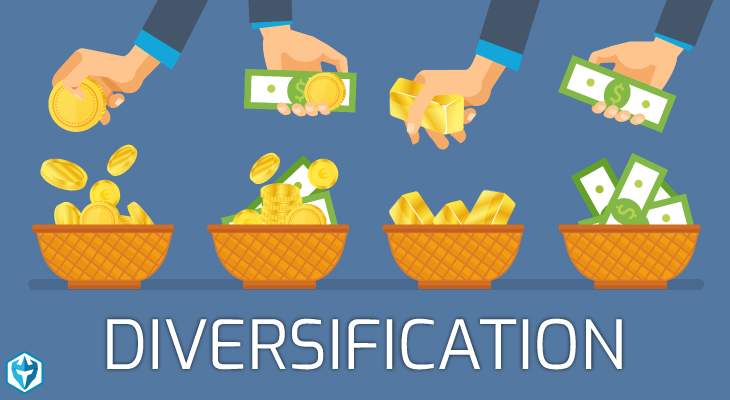
Diversification refers to the amount of variability in any group of things. You can have diversification in the foods you eat, the plants in your garden, the hobbies you enjoy and the investments you make. When you diversify your portfolio, you can mitigate many types of (but not all) risk. You might be thinking that all you have to do is own stock in more companies to be well diversified. But that’s not entirely true if the same economic factors affect the performance of all those stocks in a similar way.
What Crops Should You Plant in Your Portfolio?
If you follow the Dow Jones Industrial Average (DJIA) stock market index, there have been some doozies in both directions — up and down — over the past 25 years. From 1995 to 1999, the market was up 38%, 23%, 33%, 29% and 21%. Then it was down 9% in 2000, 12% in 2001 and 22% in 2002. It rebounded by 29%, 11% and 15% over the next few years before falling off a cliff — down 37% — in 2008, the start of the Great Recession. But that doesn’t mean all Dow stocks moved in unison in those years. The reality is that some went up and some went down. Investors who were well diversified tended to fare better in those down years than those who were not.
To build a diversified portfolio, you not only need more stocks, but more stocks that are fundamentally different from each other in terms of their response to different market forces. The way many people accomplish this is by investing in a number of stock funds (collection of stocks) that differ in important ways.
Sector funds, for example, concentrate on a particular industry such as technology, commodities, services or construction. There are small-cap funds that hold the stock of multiple companies whose total market capitalization ranges from $300 million to $2 billion dollars. And there are large-cap funds, which hold shares of businesses that have market capitalizations of $10 billion and greater, and mid-cap funds that hold stocks of those in the middle. There are also funds that mirror major stock indexes like the Dow, the S&P 500, the Wilshire 5000 and the Nasdaq, so when those indexes move up (or down), so does the value of your investment. These broad-based index funds tend to be among the most diversified.
And while you’re at it, why tie your investment returns to a single country’s economy? There are many ways to invest in foreign economies, such as mutual funds that focus on a country, region or type of economy. Investing in large-cap European companies can have a very different risk/reward profile than investing in emerging markets in Africa or Asia.
But even if you don’t have all your eggs in one stock basket, you’re still not done diversifying. There are several other types of asset classes to consider beyond equities.
Stocks and Bonds and Cash, Oh My!
Asset classes are groups of similar investments or financial instruments, and they include cash equivalents like CDs or money market funds, real estate, stocks, bonds, precious metals and so on. It’s less likely that all asset classes will decrease in value simultaneously. For example, stock and bond values often move in opposite directions as interest rates change — but by holding both stocks and bonds you can mitigate some of that risk.
Even within these classes, there are subcategories that allow for even greater diversification. And spreading your investments not only among asset classes but in different varieties of those assets can help further mitigate risk.
For example, in real estate, you could own your own home, and you could invest money to increase its resale value. Or, you could own your home and invest that extra money in rental properties. Or you could add real estate investment trusts (REITs) to the mix. All of these investments can benefit from rising property prices. However, REITs own and/or manage commercial properties, so they might be more sensitive to changes in the demand for hotel rooms or office space. On the other hand, REITs typically invest in multiple geographic locations; your home value may go down if a major employer leaves your town, whereas a REIT’s holdings might spread across many towns.
By hedging your bets with varied investments, you’re in a better position to smooth out gyrations in the market. Going back to our example of the two farmers, we saw how one type of risk (blight) selectively damaged only one type of crop. Similarly, when it comes to investments, there are certain types of risks (e.g., inflation) that can have varying or even opposite effects on different asset classes. By ensuring you have a variety of investments that are subject to different types of risk, you can potentially mitigate your downside when markets temporarily slide. Of course, certain types of risk are harder to protect against – for example a major flood or drought can hurt most crops. And similarly, a wide-reaching economic crisis has the potential of hurting the value of multiple asset classes.
But Is There Ever Too Much of a Good Thing?
The idea behind diversification is to spread out risk with investments that tend to move in opposite directions. But if your portfolio gets too diverse, with many small investments spread across a huge variety of things moving up, down and sideways, you run the risk of flattening out potential returns along with your downside risk.
Confused Yet? Don’t Worry, Help Is Available
With so many options accessible to the average investor, it can be hard to feel confident about honing in on one set of targets. That’s where your investment advisor comes in. By working with you to understand some personal preferences — such as your planned retirement age, your tolerance for risk, the size of your current nest egg and your ambitions for the value of your portfolio when you retire — your advisor can help craft a mix of investments that helps cushion the blows the market will likely deal out, while also leaving your investments room to flourish.
Source:
https://www.thebalance.com/stock-market-returns-by-year-2388543